Stop Talking About Fandom
Why Traditional Sports Marketing Frameworks Fail the Olympics

The IOC is currently reviewing every aspect of its marketing and sponsorship program. Bravo, it’s time. But here is my caveat.
Every so often, a group of “sports marketing” folks, sometimes new Olympic sponsorship staff with experience or knowledge of the NFL, NBA, Premier League, FIFA, or others, jumps into Olympic marketing discussions and begins using terms such as “fans” and “fandom” in a clinical sense. This usually involves debates about segmentation models, engagement frameworks, and loyalty metrics. These are proven, powerful tools for selling season tickets and jersey sponsorships, but they aren’t necessarily applicable to the Olympics.
Before I continue, this isn’t about semantics. “Fan” and “fandom” carry decades of specific psychological and behavioral assumptions from sports marketing research. But when someone tries to apply those words and their entire framework to the Olympic context, it’s like putting diesel fuel in a gasoline engine.
What the Industry Actually Means by “Fandom”
Sports fandom is clearly defined. It is a tribal identity built on loyalty to a specific team, club, or athlete. Robert Cialdini’s 1976 study on “Basking in Reflected Glory” (BIRGing) demonstrated that fans psychologically tie their self-esteem to their team’s wins and losses. When the team wins: “We won.” When the team loses: “They lost.” That shift in pronoun has been clear ever since team sports started. The study was replicated 40 years later in the Journal of Sport Management and remains the most cited piece of research in sport consumer behavior.
The opposite behavior, CORFing (“Cutting Off Reflected Failure”), works the same way: fans distance themselves from losing teams by putting away their jerseys, avoiding SportsCenter, and staying quiet on social media. I grew up following the Atlanta Falcons, so I know what I’m talking about. In 1990, Wann and Branscombe showed that the entire structure depends on a fixed, ongoing identification with a specific in-group. This research has led to a huge commercial industry around sports marketing.
Deloitte, an IOC TOP Partner, measures fandom across four key areas: addressable value, digital brand value, extendibility, and cultural relevance. FandomIQ tracks real-time fan engagement by detecting sentiment spikes during live matches. Analytics platforms analyze ticket sales, merchandise purchases, social media sentiment, Net Promoter Scores, and customer lifetime value. The New England Patriots even examine behavioral patterns at Gillette Stadium to predict retention.
All of these tools work effectively. And all of them assume something that doesn’t exist in the Olympic context: a fixed, ongoing, identity-defining allegiance to a specific competitive entity.
The Olympics don’t provide any of these things. Most viewers can’t name a single athlete in most Olympic sports before the competition begins. They don’t follow archery or judo between Olympic cycles. There’s no season, no fixture list, no league standings. The behavioral infrastructure that traditional fandom relies on simply isn’t present.
But the Olympics’ emotional intensity is unprecedented and staggering compared to that of traditional leagues. Paris 2024 reached roughly 5 billion people globally, 84 percent of the potential worldwide audience, according to the IOC’s post-Games report (Nielsen/Ipsos). NBCUniversal averaged 30.7 million daily U.S. viewers, up 82 percent from Tokyo. Streaming hit 23.5 billion minutes, surpassing the combined total of all previous Summer and Winter Olympics in the streaming era by 40 percent. Something massive is happening, and fan identification theory and loyalty segmentation can’t explain any of it.
The Exclusion Engine
As I’ve already written (but in case you didn’t read it), traditional sports fandom is exclusionary by design, and that exclusion is where the emotional power comes from. You cheer for the Chiefs against the Eagles. You support Manchester City at the expense of Manchester United. The joy of winning is inseparable from someone else losing. BIRGing depends on association with victory over others. Social Identity Theory sees team identification as a way to define who you are by defining who you are not. You’re a Red Sox fan partly because you’re not a Yankees fan.
The Olympics invert all of this.
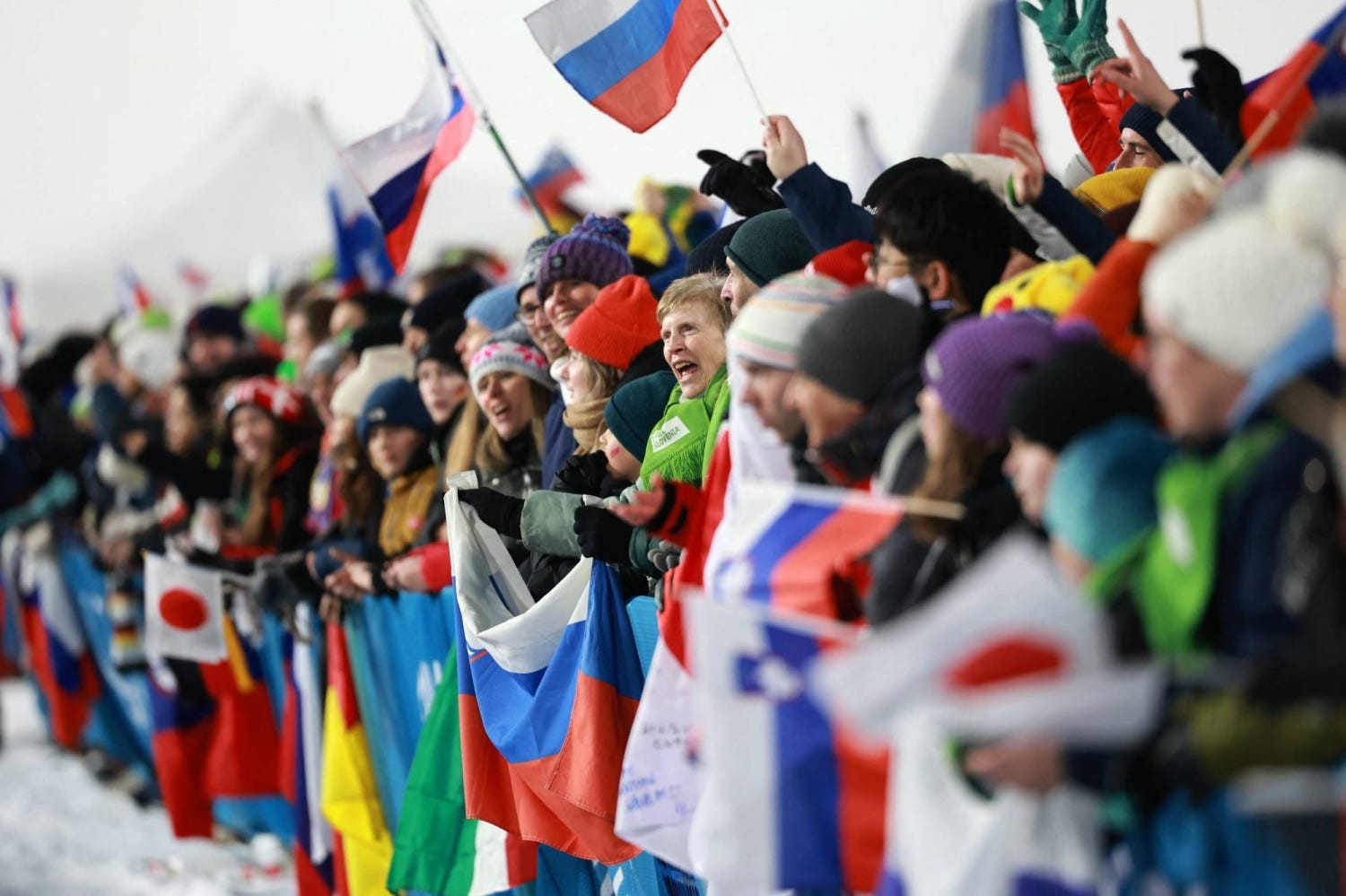
When Usain Bolt won the 100 meters, the entire stadium, with people waving flags from dozens of countries, went crazy together. When Simone Biles sticks a landing and ends up on the podium, spectators from rival countries cheer. A report from the 2026 Milan-Cortina Winter Games described crowds supporting their own teams while celebrating everyone else’s achievements; what the author called “patriotism without nationalism.”
Unlike professional competitions, the Olympics are organized by country rather than by club. Viewers don’t need to choose a franchise or follow a season-long rivalry. Identification is immediate and temporary. That structure gives even casual viewers a reason to invest emotionally, without requiring any of the ongoing allegiance that traditional fandom depends on.
Now, I can already hear the objection: “But people cheer for Team USA. Or Team GB. That’s tribal loyalty. That’s fandom.” And yes, national pride is real at the Olympics. I’m not dismissing it, but I think it operates differently from club loyalty.
An American watching the Games will cheer for Team USA and then get emotional watching a Kenyan marathoner or a Korean archer they’d never heard of an hour ago. The national allegiance is real, but it’s porous; it coexists with genuine appreciation for everyone else. Nobody at the Olympics is booing the Bhutan delegation. Compare that to what happens when away fans show up at a Premier League match.
I’ll agree that Olympic team sports like basketball and ice hockey do carry some of that tribal energy. People pick sides; they want their country to win. But those teams, that specific collection of athletes, only exist for a few weeks. They don’t play a season together, and they don’t have a home arena. There are no season tickets, and the roster changes every four years. Whatever tribal attachment forms, it forms fast, and then the team dissolves. That’s a different phenomenon than following the Lakers or the Maple Leafs across an 82-game season.
In traditional fandom, emotion is a zero-sum game, pardon the pun. Your joy means my pain. But Olympic engagement is expansive; you celebrate your country’s athletes and sometimes get choked up watching athletes from nations you might know little about. Imagine a Tottenham supporter crying happy tears when Arsenal lifts a trophy; it’s unlikely. But that kind of emotional generosity happens every day of the Olympics.
What Actually Pulls People In
A ThinkNow study prior to Paris 2024 identified three main reasons for watching the Olympics: love of specific sports, patriotism, and a desire to understand different cultures. That third reason is unique in sports fandom research; nothing else comes close. Nobody watches Monday Night Football hoping to learn about different cultures.
The IOC’s post-Paris consumer research, involving 55,000 respondents across 18 countries, revealed that 78 percent believed the Games are “more important than ever in a divided world.” Three out of four said the IOC succeeded in “bringing the world together in peaceful competition.” What attracted people was the desire to see proof that the world can unite; no loyalty segmentation model captures that.
Nielsen data consistently show that the Olympic primetime audience is about 56 percent female, nearly the mirror image of the NFL Super Bowl (54 percent male). The most anticipated Paris 2024 event, according to Gallup, was women’s gymnastics. The Science Media Centre in Spain found that a significant portion of Olympic viewers don’t follow any sporting events between Games; they engage intensely for two weeks and then disappear from the sports scene for four years. A fan engagement model based on season-ticket retention doesn’t address these viewers.
The Japan Times explored this dynamic during Milan-Cortina under a headline that could have been the title of this piece: “Why we love the Olympics — even if we’re not sports fans.” Even in Japan, where baseball, soccer, and sumo command devoted year-round followings, the Games pull in the casually interested, the indifferent, and the self-declared non-fan. Sports psychologist Yosuke Tezuka of Osaka University told the paper that social context turns casual viewers into what he called “temporary fans,” people whose engagement is real but time-limited. That’s the opposite of what any traditional fandom model measures.
Traditional sports fans watch for confirmation; they already know who they want to win. Olympic viewers watch for revelation. They want to find an athlete they’ve never heard of or see a sport they’ve never watched. The Olympics’ most iconic moments almost always feature athletes who were unknown before the Games: Hidilyn Diaz winning the Philippines’ first gold, Derek Redmond being helped to the finish by his father, Eric Moussambani swimming in a real pool for almost the first time.
Someone will point out that Simone Biles generates year-round attention. True. A small number of Olympic athletes do build something that resembles traditional fandom. But even Biles’ fandom works differently. People cheered for her in Paris and for Rebeca Andrade at the same time. The audience wanted both of them to be great. That’s not how it works when Messi plays Ronaldo.
Professor Scott Galloway (one of my favorite podcast hosts) called the Olympics “a huge collection of little stories, human moments.” You can’t calculate Customer Lifetime Value for someone whose loyalty is to the whole idea of human aspiration.
What This Costs in Practice
When non-Olympic sports marketers try to impose the fandom framework on the Games, the result is a strategy lacking relevant data. The Olympic audience can’t be segmented into loyalty groups like NFL fans divided by team; there’s no equivalent of “Chiefs fans in the Kansas City Designated Market Area.”
If the goal is to create year-round engagement plans based on 365-day content cycles, that misunderstands the cyclical nature of Olympic connection. What’s most misguided, in my view, is the effort to reduce the Olympic audience to just a sports audience, even though many of the viewers I’ve described don’t see themselves as sports fans at all. Most people who love the Olympics come for the stories, for human achievement, for national pride expressed through participation rather than winning, and for the rare experience of the entire world focusing on the same thing without arguing.
I should clarify what I’m not saying. I’m not saying don’t measure Olympic engagement. Sponsors writing nine-figure checks deserve accountability. But the traditional toolkit monitors repeat transactions and team loyalty. The Olympics require frameworks grounded in storytelling, cultural engagement, and emotional impact during events. These are quantifiable — the IOC demonstrated as much after Paris. My concern isn’t about measurement; it’s about measuring the right things.
And to those who’d say I’m being romantic about the Olympics, that at the end of the day it’s a sports property and needs to be marketed like one: the Olympics generate more reach than any sports property on earth. Five billion people for Paris. That reach exists precisely because the Olympics aren’t just a sports property. Treat them like one, and you voluntarily shrink your addressable audience to the fraction that behaves like traditional sports fans, abandoning the majority of people actually watching.
The IOC’s Paris 2024 data showed that Gen Z’s engagement with the Olympics now outperforms that of the general population in brand affinity, relevance, and emotional engagement. The drivers were inspiring athlete stories, social media buzz, and better access to content.
People who love the Olympic Games aren’t just fans of a sport. They’re part of a celebration of what humanity can become when it chooses to unite. Any marketer who tries to reduce that to the same tactics used to sell beer during Thursday Night Football is missing the point and letting down every brand that invests in the Games.
That statement, more than anything I’ve written here, makes it imperative that the IOC redouble its efforts to educate its commercial partners on why the Olympic brand is different and why that matters to consumers.
So What?
As the IOC rethinks its marketing program, the single most important thing it can do is stop borrowing frameworks and vocabularies from properties like the NFL and the Premier League, etc. Listen with caution to experts who recommend traditional sports marketing toolkits and try to fit the Olympics into them. The IOC needs to invest in building its own measurement frameworks, ones designed around narrative engagement, cultural participation, event-driven emotional intensity, and the unique cyclical nature of Olympic connection. The research after Paris proved these things are measurable. Now build the infrastructure to measure them consistently, educate your partners on what the numbers mean, and stop letting the sports marketing industry define the terms of the conversation. The Olympic brand is different.
If you’re an Olympic sponsor or considering becoming one, take a hard look at what you actually bought. It wasn’t access to a fan base; it was association with one of the few remaining moments when the world pays attention to the same thing at the same time and feels good about it. Your activation strategy should reflect that. Build campaigns around the stories, shared emotions, and values that draw in 5 billion people, even if only temporarily. In my experience, the brands that have done well with Olympic sponsorship are the ones that understood they were participating in something larger than a sports property. The ones that struggled were running their Olympic campaigns using traditional sports marketing strategies and couldn’t figure out why their brands were invisible at Games time.
Final Word
I was a new sponsor once, too. I had no idea that an Olympic sponsorship was a completely different kind of animal from a traditional sports sponsorship until I saw brand after brand and sports marketer after sports marketer try to make it fit. But the epiphany came from the IOC’s own brand research, in which consumers told us that the Olympics are not only about sport but also about the path to something greater – shared universal values.
I believe that all this connects to the complaint one hears constantly from the marketing elite, that there’s nothing happening between Games, that the Olympics need to become a 365, 24/7 property.
These are people looking at the NFL’s year-round content machine and wondering why the Olympics can’t work that way. I’ll concede that not everyone making this argument is asking for an exact NFL replica. Some are just suggesting maintaining a connection between Games, and there’s merit in that. But in practice, the proffered advice I hear always tends to go far beyond “stay connected” into full year-round content calendars, always-on social strategies, and engagement scoring models lifted directly from domestic leagues. The distance between “maintain some connection” and “become a 365 property” is enormous, and the sports marketing consulting world tends to collapse it.
Tezuka at Osaka University said it simply: the long interval between Games is what makes them rare, and the rarity is what gives them weight. People sense the extraordinary dedication athletes pour into these fleeting competitions, and that sense of a culmination, a once-in-a-lifetime moment, is what makes someone set an alarm for 3 a.m. to watch a speed skating final. Take away the rarity, and you’ve removed what makes people care.
Are there things the Olympic Movement can and should do between Games to stay connected? Probably. But the marketers pushing for an always-on Olympics are asking for something that would destroy the very thing they’re trying to monetize. The Games themselves, the gathering, the rarity, the compressed intensity of it, are the asset. Nothing in sports comes close.
***
Terrence Burns is Chairman and Owner of T. Burns Sports Group LLC. He served as Senior Vice President of Marketing at the IOC/Meridian and Chief Marketing Officer for the LA 2028 bid campaign. He has worked with Olympic sponsors ranging from Allianz to Delta Air Lines to Samsung and contributed to six winning Olympic bids over 30 years. Burns also teaches and guest lectures about Olympic branding, marketing, and the geopolitics of global sport at Emory University, Vanderbilt University, the University of Oregon, and Loyola Marymount University, among others.
Sources
Cialdini, R.B. et al. (1976). “Basking in Reflected Glory.” Journal of Personality and Social Psychology.
Jensen, J. et al. (2016). “Forty Years of BIRGing: New Perspectives on Cialdini’s Seminal Studies.” Journal of Sport Management, 30(2).
Wann, D.L. & Branscombe, N.R. (1990). “Die-hard and fair-weather fans.” Journal of Sport and Social Issues, 14(2).
Campbell, R.M. et al. (2004). “Beyond BIRGing and CORFing.” Sport Marketing Quarterly, 13(3).
Yoshida, M. et al. “Conceptualization and Measurement of Fan Engagement.” Journal of Sport Management.
Deloitte. “Understanding Sports Fandom to Unlock Value.” Deloitte Converge, 2025.
FandomIQ. “Sports Marketing Trends 2026: AI & Fandom Intelligence.” Jan. 2026.
IOC. “5 Billion People Followed the Olympic Games Paris 2024.” Olympics.com, Dec. 2024.
NBCUniversal. “Paris Olympics Dominates Media Landscape.” NBCU Press Release, Aug. 2024.
Nielsen. “How Different Genders, Ages, Races and Regions Watch the Olympics.” 2010.
Gallup. “Summer Olympics Poised to Have Record-Low U.S. Viewership.” Jul. 2024.
ThinkNow. “Audience Engagement for Paris 2024 Summer Olympics.” Jul. 2024.
Galloway, S. “Smaller.” No Mercy / No Malice, Aug. 2024.
Science Media Centre Spain. “Fans Every Four Years.” Aug. 2024.
Minneapolis Today. “Fans at Winter Olympics Reject Nationalism.” Feb. 2026.
The Japan Times. “Why We Love the Olympics — Even If We’re Not Sports Fans.” Feb. 16, 2026.
Davenport, T. (2014). Analytics in Sports: New England Patriots case study.